
Targeted Substances in Canada: What They Are and How to Track Them
Published November 3, 2026
What targeted substances are in Canadian pharmacy practice, how they differ from narcotics, and how a pharmacy tracks them with a worked count example.
Targeted substances are a category of controlled substances in Canadian pharmacy practice. The group is best known for benzodiazepines, and it also takes in certain other sedative and hypnotic drugs. They sit alongside narcotics and other controlled drugs, which is why pharmacy staff often say controlled and targeted substances together. Federal rules, not provincial ones, define which drugs belong to the category. American rules do not apply to a Canadian pharmacy, and this page covers the Canadian requirements only.
What the category covers
Before October 1, 2026, targeted substances had their own regulation, the Benzodiazepines and Other Targeted Substances Regulations. Since that date the Controlled Substances Regulations carry the rules for narcotics, controlled drugs and targeted substances together. In practice this means one set of regulations now governs the records for all three groups, while the category names still matter because they appear on supplier invoices, prescriptions and inspection checklists. Targeted substances are not narcotics, and they are not the same as ordinary prescription drugs. The difference shows up in how a pharmacy records, counts and reconciles them.
Finding the current list, and the zopiclone question
This page does not reproduce a full list of targeted substances. The list is set federally and can change, so a copy on a reference page can go out of date. The authoritative list is the one published by Health Canada, and a pharmacy should read the category for any drug from that source. Zopiclone is the drug most often asked about. Whether it is treated as a targeted substance, a controlled drug or something else is answered by the current federal schedules, so check zopiclone there rather than relying on a general page. Once the category is confirmed, it is recorded against the drug in the pharmacy's inventory so that every later count and report uses it.
How often targeted substances are reconciled
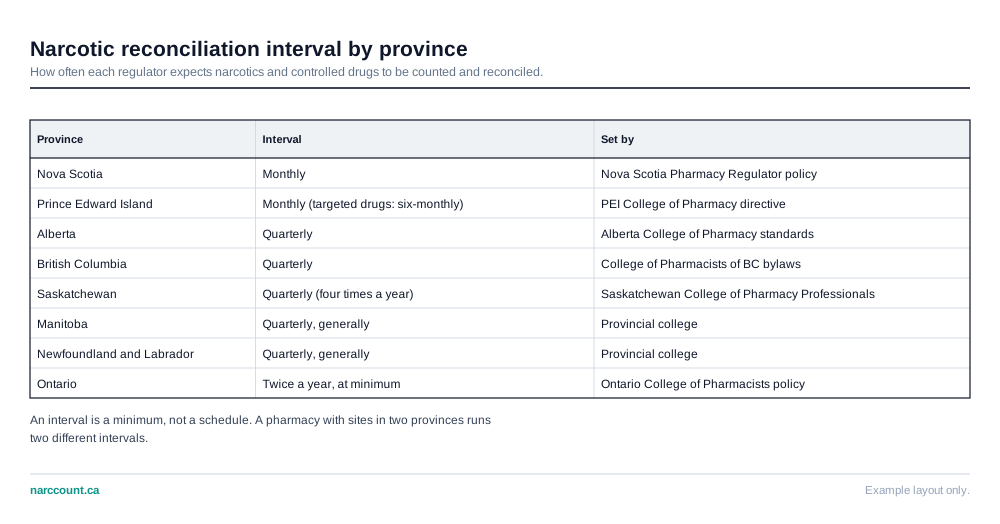
Reconciliation frequency depends on the province. In Ontario, the Ontario College of Pharmacists (OCP) expects narcotics and controlled substances to be reconciled at least every six months. Alberta, British Columbia, Saskatchewan, Manitoba, and Newfoundland & Labrador generally require reconciliation every three months. In Prince Edward Island, targeted substances are reconciled at least once every six months. Because the interval differs by province, a pharmacy that operates in more than one province will see different due dates for the same drug.
A worked reconciliation example
Take a benzodiazepine tablet at 0.5 mg. The opening count at the last reconciliation was 200 tablets. One supplier delivery added 100 tablets. Three prescriptions were dispensed at 30 tablets each, for 90 tablets in total, and none were destroyed. Expected on-hand is 200 plus 100 minus 90, which is 210 tablets. The shelf count comes to 208. The variance is 2 tablets short. The next step is to look for a cause before treating it as a loss: check whether a prescription was entered at the wrong quantity, whether a partial fill was recorded as a full one, and whether the delivery was received at 100 but entered differently. If the paperwork explains the gap, the correction is entered with a note. If it does not, the pharmacy follows its own investigation process and the reporting rules that apply to it.
Common causes of a variance
- A dispensing entry keyed at the wrong quantity or the wrong strength
- A partial fill recorded as a complete fill, or the reverse
- A delivery received at one quantity and entered at another
- A returned or expired stock entry that was never made
- A unit-of-measure mismatch, such as bottles counted as tablets
- A prescription transfer or a destruction that is missing from the ledger
- A count that was started before the last dispensing entries were posted
Keeping the records behind the count
The count is only as good as the records beneath it. Federally, narcotic and controlled-substance records must be kept at least 2 years (Controlled Substances Regulations s. 123(1), in force October 1, 2026). Provincial rules can set a longer period for patient and dispensing records, so the pharmacy's own province should be checked as well. NarcCount takes in a pharmacy's dispensing, purchase and destruction records, works out expected on-hand for each drug, and lists variances against the shelf count so that the cause can be traced entry by entry. It also keeps the supporting documentation in one place for review. It does not dispense anything and does not give professional advice.
More resources
NarcCount does the reconciliation math for you and flags every variance. Get started or read the worked reconciliation example.
General information, not legal or professional advice. For authoritative requirements, refer to the Ontario College of Pharmacists and Health Canada.